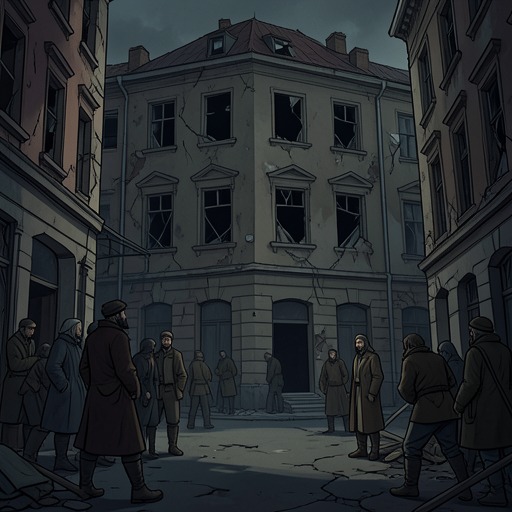
Global social collapse
Bird BoxGlobal social collapse is the widening failure of the institutions and material systems that once made ordinary life possible. In Bird Box, it begins with reports of a deadly response to seeing the creatures, then reaches into travel, communications, water, food, and public safety. The survivors’ passage from emergency orders to improvised household routines and, eventually, a self-sustaining community shows collapse not as a single moment but as an uneven struggle to replace what has failed.
Public order and the spread of fear
The early official response treats the crisis as both a public-health emergency and a threat to social order. Television reports repeatedly describe deaths by suicide, cycling through terms such as self-destruction and self-immolation; one anchorman’s phrase, personal erasing, fails to catch on. Government instructions appear on screen: a national curfew, locked doors, covered windows, and a warning not to look outside. Radio programming gives way entirely to discussion. The movement from entertainment to continuous crisis coverage makes the disaster audible and visible even as people are told to shut the outside world away.
The scale of the danger makes ordinary decisions about movement feel newly perilous. Malorie wants to drive north to the Upper Peninsula, but Shannon refuses, arguing that even a trip to the store is foolish and that a nine-hour drive would be suicidal. Her answer is not confidence in the authorities or knowledge of the creatures; it is the limited, uneasy strategy of staying put and hoping that others are safe. The loss of reliable knowledge leaves fear to govern choices that used to be routine.
The reports also turn public space into a source of dread. In Gary’s account, the attack involving two elderly sisters in Alaska becomes the evidence that finally makes the crisis feel close enough to him to act on. A woman follows them to a hospital, imagining she might help, and is killed; the televised photographs show her face removed beside her skull, while the sisters lie dead after police shoot them. The scene unsettles Gary because the people and surroundings seem ordinary. It offers no stable boundary between a familiar community and the violence overtaking it.
Infrastructure fails unevenly
When Malorie reaches the house, the breakdown has already reached communication and supply. Tom explains that the house has no Internet, that the cell phones stopped working about three weeks earlier, and that mail and newspapers no longer arrive. He suspects that the people who maintain the cell towers have stopped working or are dead. A landline still functions, but its usefulness is uncertain when there may be no one left to call. The distinction between having a working device and having a functioning network becomes crucial: the phone remains, while the system that gives it a public reach is disappearing.
Electricity and water follow different paths. The lights and landline still work because a local hydroelectric plant draws power from the river; Tom believes electricity might continue if workers have left the gates in the right position, but he cannot promise it will. The house has no running water, which failed shortly after he arrived. Water for household use comes from a well, and the river is about eighty yards behind the house. The house’s survival therefore depends on a precarious combination of an external power source, nearby natural resources, and labor performed under blindfolds.
Food stores offer only a temporary buffer against the interruption of supply. Felix says the housemates made a run for canned goods before the first reported incident in the Upper Peninsula, and that the food should last about three months. Don immediately qualifies the estimate: it will last less time now that Malorie has arrived. The exchange makes scarcity concrete in the arithmetic of an additional person. A reserve can postpone dependence on the outside world, but it cannot make that dependence vanish.
Household systems and collective strain
As municipal services recede, survival becomes a chain of household tasks. With no running water, residents fetch it from the well, use buckets instead of toilets, and carry waste to latrines dug in the woods. All of this must be done blindfolded. Felix’s trip to the well makes the procedure visible in its small safeguards: he carries one of six buckets, chooses a heavy wooden one with a black iron handle, and is tethered by a rope to a steel stake outside the back door. Old picture-frame pieces mark the path’s edges. Blindness does not stop work; it forces the housemates to redesign work around the danger.
The procedure cannot eliminate risk. When Felix returns in panic, the household’s response is immediate and confused: people crowd inside, the back door is shut, Don and Cheryl yell, Tom urges calm and tells everyone to close their eyes, and Jules demands silence. The episode shows how a breach or perceived danger can destabilize the whole group at once. Their shared rules matter, but they must be enacted through coordination in a space where nobody can simply look to assess what has happened.
Water scarcity turns the uncertainty of the well into a collective crisis. Felix’s two filled buckets remain untouched on the kitchen counter while the residents lick their dry lips; twenty-four hours have passed, and nobody knows how much longer they can go without drinking. Tom argues that they cannot endure days without water and invokes the baby Malorie is carrying. Malorie answers that the baby is precisely whom she is thinking about. The exchange does not settle whether the water is safe; it shows the personal and collective cost of having to decide under conditions where waiting can itself become dangerous.
Malorie’s response to mounting panic is to convert the household’s remaining capacity into assigned work. She calls for dinner to be prepared, the waste bucket to be emptied, the cellar to be better arranged, and the yard to be searched for tools. She assigns Cheryl to feed the birds, Gary and Don to make calls using every combination of numbers, and Olympia to wash bedding that has not been cleaned for a week. The plan is practical rather than grand: food, sanitation, useful equipment, attempted communication, and clean sheets. The others initially look at Malorie as if she were a stranger, but they begin to act. In this household, organization is a form of resilience precisely because it addresses ordinary tasks that panic threatens to erase.
Competing responses to the disaster
The collapse also produces competing explanations and rival models of action. Gary tells the household about a former housemate who believed the creatures were harmless and that the apparent insanity resulted from the reactions of people who saw them. In Gary’s telling, this man dismissed the creatures’ effects as psychosomatic. The existence of such a theory does not resolve the danger; it shows how uncertainty can generate an alternative account that challenges the survivors’ governing assumptions.
Gary’s story of his former house also traces how fear can organize people into a different kind of danger. After the Alaska reports, Kirk treated the events as an invasion and developed plans involving weapons, equipment, and military-style drills, despite never having enlisted. Men gathered around his self-appointed leadership and talked of protecting the city, eliminating the cause, and securing a place in history. Their claims did not lead to action that could protect anyone. Frank, by contrast, withdrew to a second-floor bedroom and wrote intensely about what he saw as an overreactive society. The house contains both the fantasy of restoring order through force and the attempt to record and criticize the panic it produces.
The breakdown of ordinary coordination does not mean every community meets the same end. At Tucker, Rick describes an early period of hunger and insecurity in which a creature entered while a group was out searching for food. Several people died, and a mother killed four children during a fit of rage. The community took months to recover and vowed not to risk another breach. Its members blinded themselves with forks, kitchen knives, or their fingers, believing blindness provided absolute protection. After a year of fortifying the facility, they eased that burden; Rick says there have been no security lapses since. Constance’s unscarred face confirms to Malorie that not everyone at Tucker has undergone the earlier self-blinding practice.
From emergency survival to a new community
Tucker’s later conditions mark a substantial change in what communal survival can offer. Rick describes a facility without windows, with running water and its own food production, enough bedrooms, and a degree of self-containment he considers better than life before. After the Boy and Girl remove their blindfolds there, the children see the outside world for the first time in their lives. Rick tells them that the facility grows its own food and has captured chickens for eggs, a cow for milk, and two goats that can be bred; the residents hope to search for more animals and establish a small farm. For children raised in isolation, even the prospect of goats represents a new encounter with living animals, not merely a fuller pantry.
The movement from curfew and sealed windows to Tucker’s gardens, livestock, and running water is not a return to the former social order. It is evidence of adaptation through collective labor, security measures, and local provision. Across the novel, the same systems that make life possible also reveal distinct vulnerabilities: a functioning telephone without a reachable network, electricity dependent on a river and an unattended plant, stored food measured against the number of mouths, and water that must be fetched without sight. The scale of collapse is global, but the work of surviving it is repeatedly local, measured in guarded doors, filled buckets, assigned chores, and a community trying to make the next day materially possible.